Showing posts with label Volume 3. Show all posts

Tuesday, February 10, 2015

{Handicrafts} :: Bug House

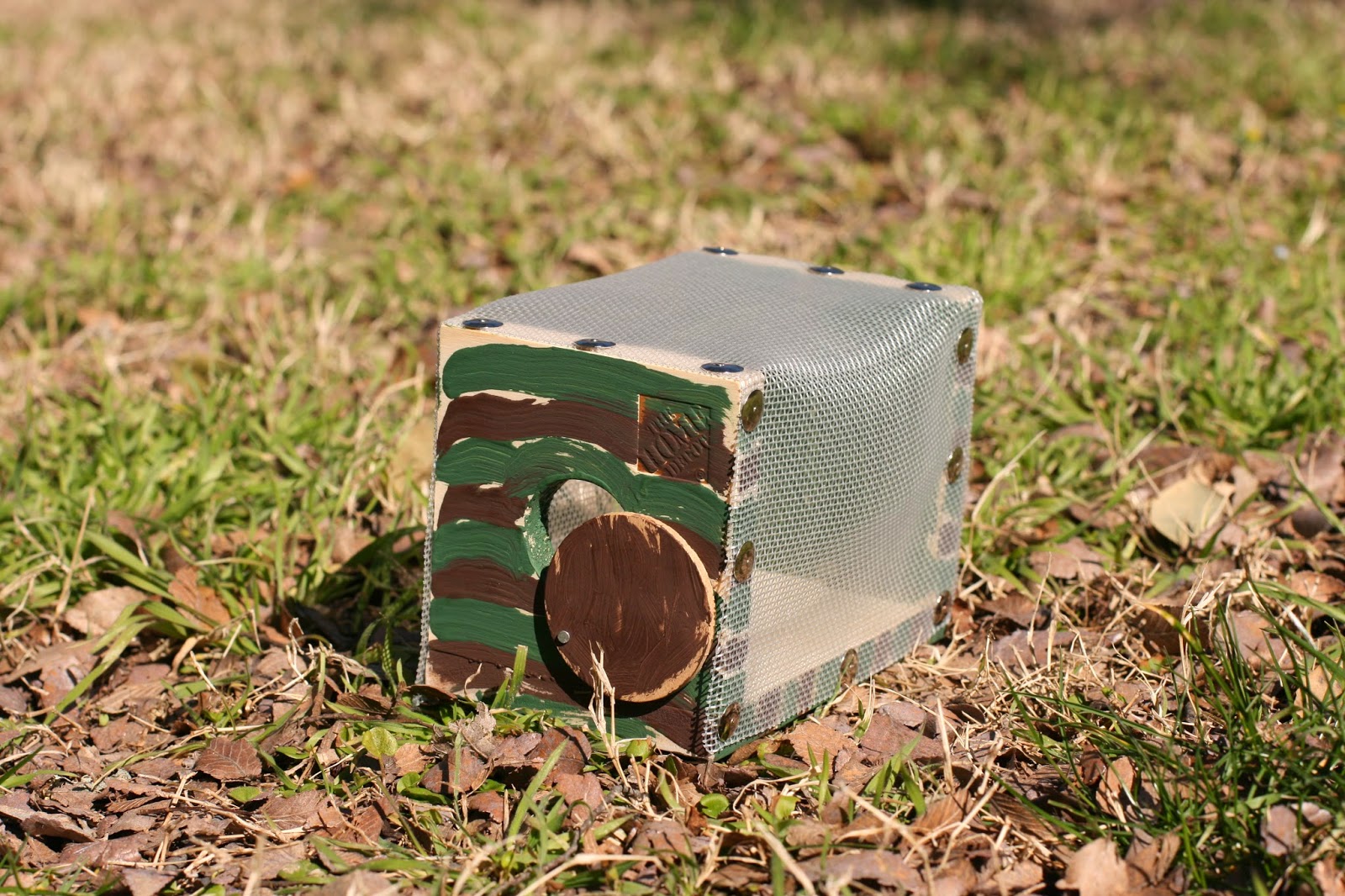
This little DIY project set was a gift from some good friends of ours awhile back: a bug house to build.

I am trying to find practical handicrafts for Royal and Alice ... things that they both will enjoy. 
So I figured after the hand-stitched cards, I had better look for something more boyish. 
But, as it happens, both kids really like trying their hand at these seemingly gender-specific handicrafts.


That is the capital charge against most schools.
The teachers underrate the tastes and abilities of their pupils.
-CM, Vol 6: A Philosophy of Education, p 52


Our aim in education is to give children vital interests in as many directions as possible 
-- to set their feet in a large room -- 
because the crying evil of the day is, it seems to me, intellectual inanition.
-CM, Vol 3: School Education, p 231

...
So we talked about sanding, and how you need to take note of the direction of the wood's grain. 
(Oh, and what is "grain"?)
 So we defined that, then decided which way we should sand before getting to work...


After preparing a nice, smooth surface, we used a little wood glue and nailed the frame together.
We talked about how to hold a hammer properly to get maximum power out of your swing.


Don't you just love Alice in her Little House attire?


So after the wood glue dried, Royal went on to paint the house camouflage...


And then after tacking the screen around, it was finished.


Now just to wait for spring when bugs abound!


Wednesday, March 19, 2014

Moral Teaching: a Personal Testimony

But I don't want to!


image from: planetpov.com

How many times have we said this growing up? And now, as mothers, how many times shall we hear it again? 

Not long ago, in my young adult life, I said this over and over again to the urging of my mother to get my teaching degree. Then after college I wandered aimlessly about for a couple of years with no real purpose on this earth but to seek my own pleasure and find my own way.

I returned home after a few months out of the country...lost, confused and spiritually barren. What was I doing? Where was I going? Why was God absent?

Then after a series of circumstances, the main one being that I began to relinquish my own desires for what the Lord might have for me, I began to draw nigh to the Lord and seek His will over mine. 


Submit yourselves, then, to God. Resist the devil, and he will flee from you. Come near to God and he will come near to you. Wash your hands, you sinners, and purify your hearts, you double-minded. -James 4:7-8

After this (and getting married), I needed to find a job...no, a career, to support my husband through Seminary. Well guess what? I felt the holy nudge to interview for a junior high Spanish teaching position. During the interview, for the first time in my life I had the overwhelmingly clear sensation ... like a peace wash over me ... that this is what God wanted me to do. I was offered the job without having any teaching certificate on the condition I would work towards and acquire it during the following 3 years. 

I accepted.

I tell this very condensed version of my life story only to give a living example of "But I don't want to!" ... followed by several years of living in confusion and spiritual torment ... to "But I ought to...and I will." I finally came to the place where I was tired of being selfish and decided to let God prove Himself to be all He said He is. And I would obey and follow Him, as I ought. If I say with my mouth that He is my Lord, then I owe it to Him to show that I believe it by following and serving Him in obedience.

'Ought' is part of the verb 'to owe,' and that which we owe is a personal debt to a Lawgiver and Ruler. -Vol 3, p 126

Was I forced to accept the teaching position? Of course not. But had I disobeyed (or ignored) God's urging Spirit, I would not have experienced first-hand His power working through me during the following 5 years of teaching...nor would I have been as prepared for the next steps of obedience that would come after this.

Even the divine authority does not compel. It indicates the way and protects the wayfarer, and strengthens and directs self-compelling power. It permits a man to make free choice of obedience rather than compels him to obey. -Vol 3, pp 127-128

So what wisdom can we impart to our precious children from our own experiences of choosing "ought" over "want" and willing ourselves to submit to our Higher Authority? Or maybe the opposite: choosing "want" over "ought" and falling into the dregs of stubbornness and selfishness? I can testify that it brings many an opportunity to share with my children in both instances! 

So when I hear, "But I don't want to!" when I ask my daughter to clean the table or my son to pick up toys, I remind them that it is their duty... that I still have to do things I do not feel like doing, but must (like wash the dishes and change dirty diapers)... that they also must learn to do things that are right and necessary even if they don't feel like it ...

because this is just the beginning of learning to obey the Lord.


Saturday, February 8, 2014

Can Reason be Unreasonable?

As some of you also may have tuned in to the debate on the origins of the world between Ken Ham and Bill Nye online the other night, you may be aware of hundreds upon hundreds of responses in favor of (or opposed to) one man or the other. And regardless of your personal opinions of either one, you will most likely find yourself in the Ham camp or the Nye camp.


With this atmosphere in place, I read through the first portion of Charlotte Mason's School Education (Chapter XI, Volume 3): Some Unconsidered Aspects of Intellectual Training

So I venture to ponder the power of reasoning...

Wouldn't you suppose that, as scientists, both Ham and Nye have a very powerful reasoning capacity? Isn't that a lot of what science is? The ability to study, observe, deduce...reason

And wouldn't you suppose that this power is a conscious effort put forth?

Wouldn't you also suppose that much of this power is a gift put into hours and hours of practice?

---------------------------------------------------

Miss Mason proposes that this power is actually quite limited in nature and function.


We all know how often we go to bed with a difficult question to settle. We say we will sleep upon it, and, in the morning, behold, the whole question has worked itself into shape: we see all its bearings and know just how to act.

Children should be taught to know that much of our reasoning and so-called thinking is involuntary, --is as much a natural function as is the circulation of our blood, and that this very fact points to the limitations of reason. -Vol 3, p. 115

And regarding the apparent and marked ability of those we label as "gifted", Mason merely states that these people have employed and practiced intellectual habits.

They make a man able to do that which he desires to do with his mental powers. -Vol 3, p. 118

The habits in question are acquired through training and are not bestowed as a gift. Genius itself...is an infinite capacity for taking pains. -Vol 3, p. 119

----------------------------------------------------

I do agree that scientists such as Ham and Nye have a great power to reason and think things through. But are any of their reasoned viewpoints unreasonable?

I read in Volume 3, p. 116 the reasoning power, acting in a more or less mechanical and involuntary manner, does not necessarily work towards the morally right conclusion. 

Couldn't this also be true regarding arriving at the scientifically or ethically or spiritually right conclusion?

All that reason does for us is to prove, logically, any idea we choose to entertain. 

We all know that, entertain a notion that a servant is dishonest, that a friend is false, that a dress is unbecoming, and some power within us, unconsciously to us, sets to work to collect evidence and bring irrefragable proof of the position we have chosen to take up.

How necessary then that a child should be instructed to understand the limitations of his own reason, so that he will not confound logical demonstration with eternal truth.

Vol 3, p. 116

--------------------------------------------------

Could your reasoned conclusions of any particular point be unreasonable?

How do we know if they are? 

And how do we change, if so?

I propose we look to the One Who has no limitations and Who never changes.
Let's take a peek through His lens. 

Friday, January 24, 2014

Some unconsidered aspects of physical training

When I saw this as the topic of conversation for the January Charlotte Mason blog carnival, I wondered if it was chosen as anticipation for the 2014 Winter Olympics. I don't know if that is true, but it made me want to read this portion of Volume 3: School Education.


As habit is central to the Charlotte Mason livelihood, and well should be the crux of our lives as successful persons, I consider the Olympic athlete to have mastered this portion of their physical attainments.

I played sports growing up. Volleyball, basketball, track. I even went on to play volleyball in college. It started out as something enjoyable, just something extra to have my hand at. And that is what draws us to about anything new, I suppose. 

"The object of the fine physical culture...is...that they may get the most...out of life...for their own pleasure." -p. 102

As I continued in my athletic endeavors, training became more intense...even to the point of losing my lunch a few times from so much physical exertion. So did this make me throw in the towel? Did it make me say, "Forget this!" Well, no. Honestly, I loved the competition and results too much to give up that easily.

"Enjoyment is good by the way, but is not the end." -p. 102

And as I pressed on to more lofty athletic attainments, I could look back and see that a continuous, habitual routine of exercise had given me (through many years of sweat and exhaustion), a position to agree with Charlotte Mason whole-heartedly.

"...for the disciplined life has more power of fresh enjoyment than is given to the unrestrained." -p. 103

Although I was nowhere near Olympic heights, I have at least an inkling of an understanding as to how much habit (and heart) go into the sacrifices these athletes make on a daily basis in order to attain just the possibility to compete with others who have also beat their bodies into submission...to show the world just what a body can do out of the "splendid material" God has given them.